Export more blogs
Intro
When I start reading an English article, I usually understand most of it.
I can follow the topic, recognize many words, and get through the article by looking things up when needed. At the beginning, I check unfamiliar words frequently, sometimes almost line by line.
By the time I finish reading, everything feels clear.
But a few days later, when I see the same words again, I realize I’ve forgotten most of them.
I remember looking them up, but not remembering them.
This isn’t a rare experience. For many English learners, the real frustration doesn’t happen during reading — it happens after reading.
Why constant lookups don’t lead to lasting memory
Looking up words while reading feels productive.
Each lookup gives immediate clarity, and the article becomes understandable. However, this clarity is temporary.
When words are looked up once and never seen again, the brain treats them as disposable information. They help in the moment, but they don’t get stored.
The problem isn’t checking words — it’s only checking them once.
Without repeated encounters, the brain has no reason to keep them.
Understanding an article doesn’t mean learning its vocabulary
Finishing an article creates a strong illusion of learning.
You understand the ideas. You remember the topic. You feel like progress was made.
But vocabulary learning works differently from content understanding.
Understanding an article is a one-time task. Remembering words requires multiple exposures over time.
This is why many learners feel confused:
“I clearly remember reading this word before — why does it still feel new?”
Because recognition hasn’t been trained, only comprehension.
The real issue: vocabulary disappears after reading ends
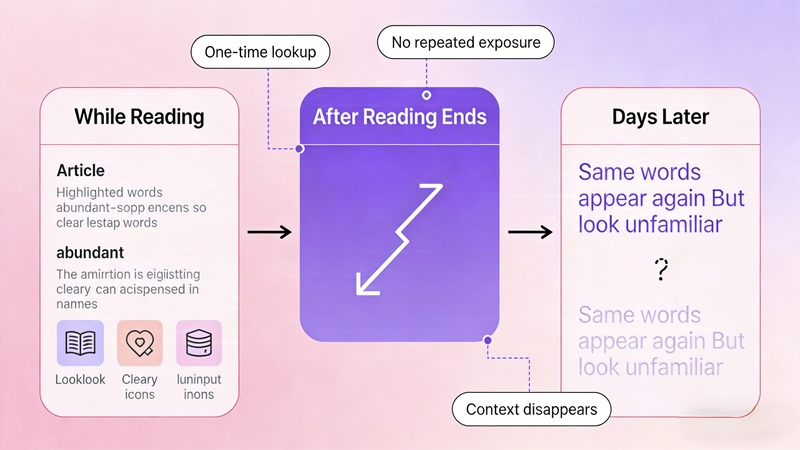 Most vocabulary loss happens after reading, not during it.
Once the article is finished:
- The words don’t reappear
- There’s no follow-up exposure
- The context disappears
From the brain’s perspective, the word’s “job” is done.
Without future signals that the word is useful, memory fades quickly — often within days.
This creates a frustrating loop:
read → look up → finish → forget → repeat
What actually helps words stay in memory
Vocabulary sticks when words don’t disappear after a single article.
Long-term retention depends on:
- Seeing the same word again in different articles
- Encountering it naturally, not intentionally
- Meeting it without interrupting reading flow
When words reappear across multiple readings, the brain begins to recognize them as important.
At that point, remembering no longer requires effort — familiarity builds on its own.
A better way to approach reading English articles
Instead of trying to fully “learn” every word in one article, a more effective approach is to treat reading as ongoing exposure.
This means:
- Accepting that one article is not enough
- Letting words return naturally
- Focusing on recognition over perfection
Tools like NeonLingo are designed around this idea — helping words you’ve already looked up show up again while you read, so vocabulary doesn’t vanish after the article ends.
Learning doesn’t need to happen all at once. It needs to happen repeatedly.
Benefits of focusing on retention, not just comprehension
When vocabulary learning continues after reading ends:
- Fewer words feel “new” each time
- Reading becomes faster over time
- Lookup frequency naturally decreases
- Frustration drops significantly
Most importantly, learners stop feeling like their effort is wasted.
FAQ
Why do I remember the article but not the words?
Because articles are understood once, while words need repeated exposure. Without seeing them again, memory fades quickly.
Should I stop looking up words when reading?
No. Lookups are helpful — but they need follow-up exposure. One-time lookups rarely lead to retention.
Is it normal to forget words after reading?
Yes. It’s extremely common and expected without repetition. Forgetting is not a failure; it’s a signal that exposure was insufficient.
How can I reduce forgetting after reading?
By encountering the same words again in future readings, ideally without breaking reading flow.
Conclusion
The hardest part of reading English articles isn’t understanding them. It’s keeping the words after the reading ends.
When vocabulary is allowed to reappear naturally across different articles, memory finally has a reason to hold on.
Reading doesn’t fail learners. Forgetting happens when words only appear once.